OpenClaw + Dream vs. Executive Assistant — 500d
This report covers a 500-day Recall Bench run of the OpenClaw agent answer-loop backed by the Dreamweave consolidation engine — the same openclaw[vector:text-embedding-3-small+agent] retrieval/answer path, but with a nightly dream pass that consolidates near-duplicate restatements into gists, retains their constituents as tier-2 detail, links supersede/sequence edges, and serves recall from a graph rather than a flat vector index. It is the natural comparison to the published plain-vector OpenClaw 500d run: same persona (Jordan), same qa-500d question set, same agent loop and judges — the variable is the memory engine.
Source artifacts in-repo:
bench-results/openclaw/ea-500d-dream/(this run —result.json,progress.jsonl,failures.jsonl,heatmap.png)bench-results/openclaw/ea-500d-vector/(baseline)
Table of contents
TL;DR
| Dream 500d (this run) | Plain-vector 500d (baseline) | |
|---|---|---|
| Adapter | openclaw[vector:text-embedding-3-small+agent] + dream(judge:gpt-5.4-mini, tier2=50000, incr) |
openclaw[vector:text-embedding-3-small+agent] |
| Checkpoints | 50 (every 10 days, 10d–500d) | 50 (every 10 days, 10d–500d) |
| Questions evaluated (total) | 3,164 | 3,168 |
| Unique Q&A pairs | 878 | 878 |
| Overall composite (first → last quartile) | 5.60 → 5.15 (avg 5.32) | 5.24 → 4.98 |
| Hallucination rate (first → last quartile) | 4.5% → 10.2% (avg 7.7%) | 13.6% → 18.2% |
| Hallucination peak | 16.2% (470d) | 27.1% (300d) |
| Worst per-category | temporal-reasoning 4.60 (4.50 → 3.90) |
temporal-reasoning 3.89 (4.38 → 3.40) |
| Strongest per-category | contradiction-resolution 5.63 · negative-recall 5.57 |
factual-recall ~5.18 |
Headline: adding the Dream consolidation engine to the same OpenClaw answer loop lifts the overall composite (5.32 vs 4.98 at the last quartile) and — most importantly — roughly halves the hallucination rate (7.7% avg vs the baseline’s 13.6% floor / 18.2% last-quartile), with the peak dropping from 27% to 16%. Every scored category improves. The consolidation-and-supersede structure is doing exactly what it’s meant to: collapsing the daily-restatement flood that drives the plain-vector run’s confident-fabrication failure mode. Temporal reasoning remains the weakest category even with dreaming (4.60), and is still where future work should concentrate.
Fairness note. This is an engine-level comparison, not a perfectly controlled A/B: the Dream run ingests the canonical
memorySavefact stream (tools-500d) through the consolidation engine, while the plain-vector baseline ingests the rawmemories-500dday files and lets its own extractor build chunks. Persona, question set, checkpoint grid, agent loop, and both judges are identical. Treat the per-category deltas as the effect of the whole dream ingestion+recall path, not of a single isolated knob.
The run at a glance
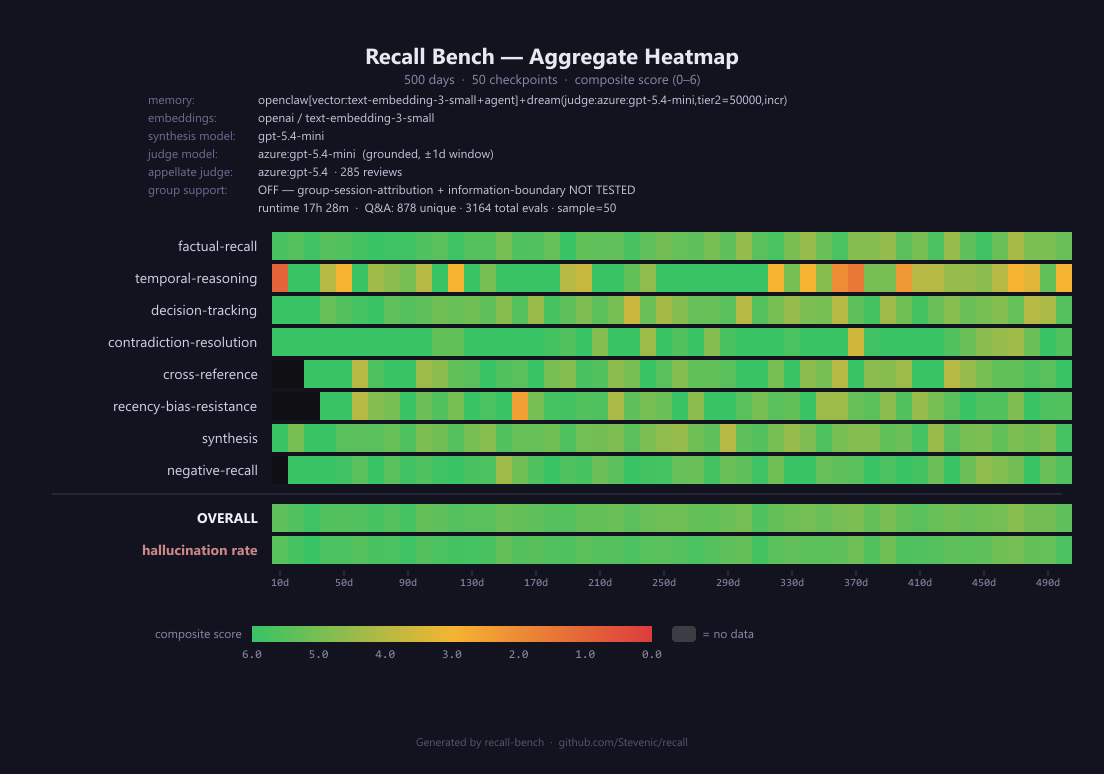
50 checkpoints stepping every 10 days from day 10 to day 500, composite score 0–6 per category × checkpoint. The grid is almost entirely green: the overall composite holds a tight 5.1–5.6 band across the full year-and-a-half horizon with no catastrophic-forgetting cliff. The single visibly hotter row is temporal-reasoning, which flickers orange/red at scattered checkpoints (it is also the lowest-questionCount category, so individual checkpoints swing hard). Run time was 17h 28m; 878 unique Q&A pairs, 3,164 total evaluations, sample=50 per checkpoint, appellate judge invoked 285 times.
Engine configuration: nightly consolidation runs report → (LLM judge) → apply over entities, aliases, salience, merges, and synthesis, with tier2Max=50000 (the benchmark deliberately disables tier-2 archiving so nothing falls out of the retrievable set over 500 days) and incremental weave. Recall is served by the graph engine (recall.js) with activation reranking, hybrid dense+sparse seeding, and supersede/sequence-aware surfacing.
How the score breaks down
Recall Bench scores every Q&A pair across three sub-dimensions:
correctness (0–3) + completeness (0–2) + hallucination (0–1) = composite (0–6)
The hallucination dimension is binary and independent — a question can be correct but hallucinated (a lucky guess) or wrong but not hallucinated (retrieved the wrong real memory). See the Recall Bench overview for the full rubric and category definitions. As in the other EA runs, group-session-attribution and information-boundary are disabled (groupsEnabled: false) — the dream engine has no per-session ACL concept — so those rows are dark.
Per-category breakdown
Quartile averages (weighted by per-checkpoint question count). “Δ” is the change from the first quartile of checkpoints (10d–120d) to the last (390d–500d). Baseline column is the published plain-vector 500d run for the same category.
| Category | Avg | Qs | First quartile | Last quartile | Δ | Baseline avg |
|---|---|---|---|---|---|---|
factual-recall |
5.39 | 989 | 5.75 | 5.09 | −0.66 | 5.18 |
temporal-reasoning |
4.60 | 122 | 4.50 | 3.90 | −0.60 | 3.89 |
decision-tracking |
5.12 | 461 | 5.55 | 4.98 | −0.56 | 4.97 |
contradiction-resolution |
5.63 | 220 | 5.87 | 5.40 | −0.46 | 5.45 |
cross-reference |
5.29 | 173 | 5.24 | 5.16 | −0.08 | 4.87 |
recency-bias-resistance |
5.32 | 240 | 5.26 | 5.37 | +0.11 | 4.74 |
synthesis |
5.15 | 472 | 5.43 | 5.19 | −0.24 | 4.95 |
negative-recall |
5.57 | 487 | 5.82 | 5.43 | −0.38 | 5.18 |
| OVERALL | 5.32 | 3,164 | 5.60 | 5.15 | −0.45 | 5.11 |
What this tells us
Every category beats the plain-vector baseline. The largest lifts are exactly the categories the daily-restatement flood hurts most in the vector run: recency-bias-resistance +0.58 (4.74 → 5.32), cross-reference +0.42, negative-recall +0.39, synthesis +0.20. Consolidation collapses the ~86%-of-daily-writes that are restatements into gists, so a query’s top-K is no longer dominated by near-duplicate chunks of the freshest topic — which is the mechanism behind the baseline’s recency-bias and cross-reference weakness.
Recency-bias-resistance is the standout structural win. It is the only category that is flat-to-rising across the horizon (Δ +0.11) rather than eroding — a direct consequence of supersede-aware surfacing keeping an old, un-referenced fact retrievable instead of letting fresher chunks bury it. In the baseline this category collapses to 3.98 by the last quartile; here it holds at 5.37.
Temporal reasoning is still the weakest category — and still the frontier. Dreaming lifts it materially (4.60 vs 3.89 baseline; last quartile 3.90 vs 3.40), and the sequence-edge + supersede work is why. But “when did X happen relative to Y?” and “what changed between day N and day M?” questions remain the hardest: the answer often requires reconstructing a local timeline that no single retrieved node carries, and the small question count (n=122) makes individual checkpoints volatile. This is where the next lever lives.
The graceful-decay story holds. Overall composite drifts from 5.60 (first quartile) to 5.15 (last) — a −0.45 slope over 490 days with no cliff. Factual and negative recall stay strong throughout; the erosion is concentrated in the reasoning-heavy categories, as expected.
Hallucination trajectory
The hallucination rate is the share of answers the judge scored as fabricated (at least one unsupported claim).
| Dream 500d | Plain-vector 500d | |
|---|---|---|
| First-quartile avg | 4.5% | 13.6% |
| Last-quartile avg | 10.2% | 18.2% |
| Median checkpoint | 7.5% | 17.6% |
| Min checkpoint | 0.0% (30d) | 0.0% (10d) |
| Max checkpoint | 16.2% (470d) | 27.1% (300d) |
This is the clearest win in the run. The Dream engine’s entire hallucination trajectory sits below the plain-vector run’s first-quartile floor. Where the baseline crosses ~6 months and fabrication becomes the modal failure (13.6% → 18.2%, peaking at 27%), the dream run stays in a 4.5% → 10.2% band and never exceeds 16.2%. The reason is the same as the recency-bias win: with the daily-restatement flood consolidated away and supersede edges marking stale versions, the agent retrieves a smaller, cleaner, correctly-versioned candidate set, so it synthesizes fewer confident-but-wrong answers. It doesn’t eliminate the confident-fabrication failure mode the plain-vector postmortem identified — it substantially reduces its frequency.
Findings & operational notes
Finding 1 — Consolidation is the hallucination lever
The plain-vector postmortem’s dominant failure mode was confident fabrication — when wrong, the agent is almost always confidently wrong, usually by latching onto the most-frequently-restated entity. Halving the hallucination rate without touching the answer prompt confirms that a large share of that failure is retrieval-side flooding, not an irreducible LLM behavior: give the answer loop a de-duplicated, version-aware candidate set and it fabricates far less.
Finding 2 — Temporal reasoning is the remaining frontier
Even with sequence edges and supersede-aware surfacing, temporal-reasoning is the weakest category (4.60) and the one most worth the next iteration. The residual misses are “reconstruct the local timeline around a cued date” questions where the answer is spread across nodes no single retrieved fact spans. This is a representation/surfacing problem, not a storage one — the constituent facts are retained.
Operational note — ingest cost at tier2Max=50000
Running the benchmark with tier-2 archiving effectively disabled (tier2Max=50000, so the active set grows unbounded over 500 days) exposes an O(N²) term in the nightly consolidation’s candidate-emission step: per-checkpoint ingest climbs from ~30s early to 20+ min in the back half, dominating the 17.5h wall clock. This is a benchmark-configuration artifact, not a production characteristic — in normal operation the tier-2 cap bounds the active set and keeps nightly cost bounded. An earlier attempt to bound cost by recency-gating the consolidation seed set was reverted after review: synthesis eligibility is decay-triggered, not arrival-triggered (slow, class-dependent half-lives), so any recency window silently drops slow-decay fact families — a correctness regression for a non-durable cost win. The semantics-preserving fix for the uncapped configuration is an ANN index confined to the KNN-edge step (O(N²) → O(N log N)), left as future work; the production path relies on the active-set bound instead.
What we’d test next
Not a fix list — the cheap questions this run raises:
- Isolate the ingestion variable. Run the dream engine against the raw
memories-500dday files (its own extractor) rather than the canonicaltools-500dstream, to separate “consolidation+recall” from “cleaner fact input” in the per-category deltas. - Temporal-reasoning targeting. The category is the frontier. A run that reconstructs a local timeline at recall time (chronological gather around the cued date/anchor) rather than returning ranked isolated facts would directly test the representation hypothesis.
- Does the win hold past 500d? The overall slope is a gentle −0.45/quartile with no cliff. A 1000d run would show whether consolidation keeps the decay linear or whether an uncapped active set eventually reintroduces flooding.
- Cap sensitivity. Re-run at a production-realistic
tier2Max(e.g. 2500) to confirm the recall-quality wins survive active-set bounding and to measure the nightly-cost recovery.
Each is a single-profile change plus a re-run; adapter, corpus, and scoring stay fixed.
How to reproduce
The run uses the OpenClaw harness (bench-harnesses/openclaw/) built against an OpenClaw checkout, with the memory backend pointed at the Dreamweave engine (spqian/dreamweave, main). The profile is:
packages/recall-bench/profiles/ea-openclaw-armB-500d-50k.yaml(enginePath→ the dream engine,tier2Max=50000, incremental weave,dreamModel: azure:gpt-5.4-mini)
Run and monitoring follow the standard operator playbook in bench-program.md. The judge/appellate models are Azure-hosted (gpt-5.4-mini / gpt-5.4), and the embedding shim serves 1536-dim text-embedding-3-small. The heatmap is regenerated from result.json with node scripts/generate-heatmap.mjs --input <result.json>.
Raw artifacts (result.json, progress.jsonl, failures.jsonl, heatmap.png) live under bench-results/openclaw/ea-500d-dream/ and are the source of every number in this report. The full per-question log (armB-questions.jsonl, ~23 MB) is not committed for size but is regenerable from the profile.